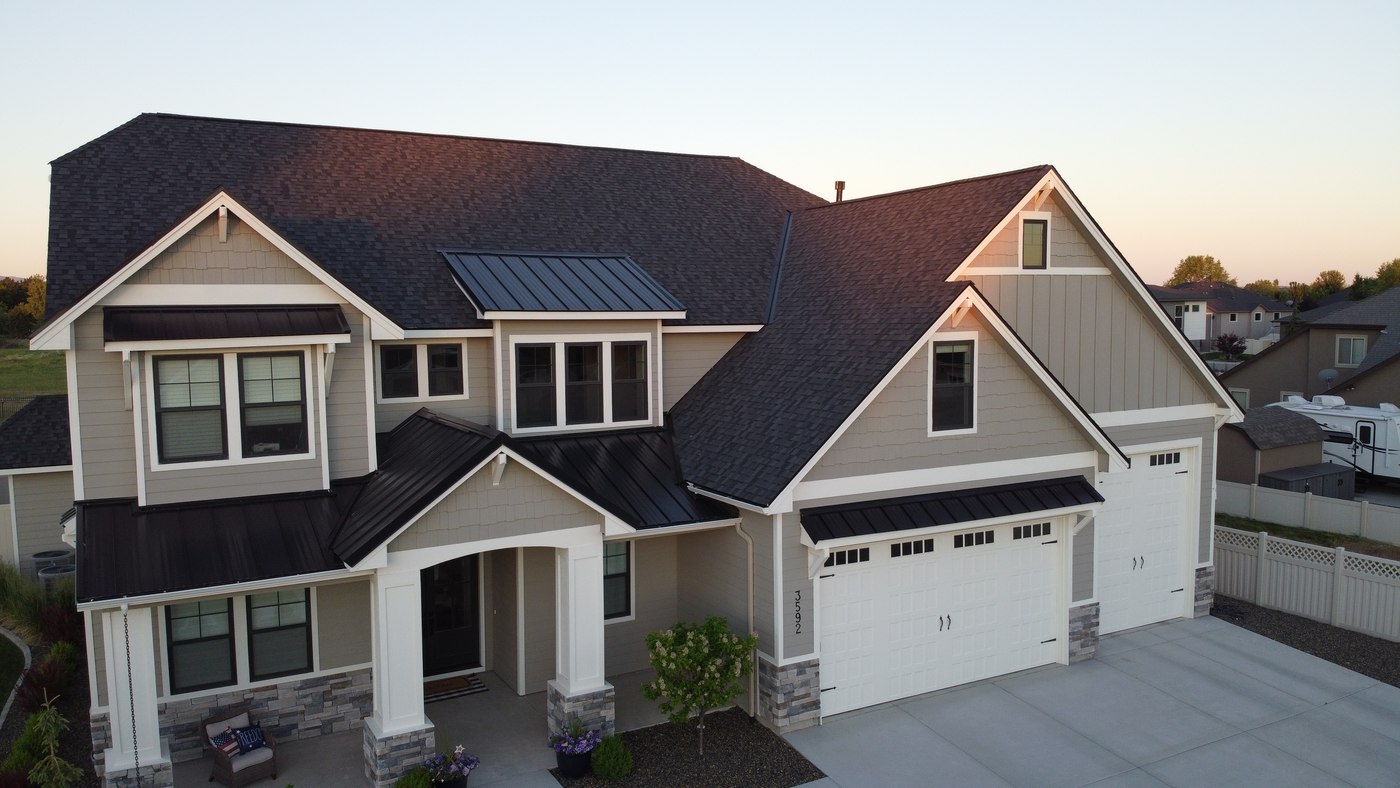
The question comes up on nearly every estimate we do for a homeowner who's replacing a roof rather than repairing it: metal or shingles? Both are good options in The Treasure Valley, and the right answer depends on your timeline, your budget, and how long you plan to stay in the home.
Cost comparison
For a typical 2,000 square foot Boise home, architectural asphalt shingles run $12,000 to $18,000 installed. Standing seam metal roofing for the same home runs $25,000 to $40,000 depending on profile, coating, and roof complexity. Metal costs roughly twice as much upfront.
The lifetime cost comparison is closer than the upfront numbers suggest. A homeowner who installs architectural shingles today will likely replace that roof again in 25 to 30 years -- paying the full installation cost twice, plus the disruption of a second project. A metal roof installed today may still be in service in 50 years. When you divide the total cost by years of service, the per-year cost of metal and shingles often comes within a few hundred dollars of each other for homeowners who plan to stay long-term.
Lifespan in Idaho's climate
Architectural asphalt shingles in Boise's climate realistically deliver 22 to 28 years with good maintenance. Idaho's combination of UV exposure, freeze-thaw cycling, and periodic hail shortens the manufacturer's rated lifespan. Standing seam metal is largely unaffected by UV and handles freeze-thaw cycling without the granule loss and binder degradation that afflicts asphalt. In the mountain communities -- McCall, Donnelly, New Meadows -- where snow loads are significantly heavier, metal's advantage grows further because it sheds snow naturally where asphalt shingles accumulate it.
Performance in Idaho weather
Metal holds up well in hail events. A hailstone that strips granules from an asphalt shingle -- effectively ending that area's weather protection -- will dent a metal panel without compromising the panel's ability to shed water. Cosmetic denting is the typical result of a significant hail event on metal, not structural failure. For Boise and Eagle homeowners whose asphalt roofs have been through multiple hail events, the upgrade to metal represents a meaningful reduction in future hail risk.
Metal's noise during rain is often cited as a concern and rarely becomes an actual one. Standing seam installed over solid decking with underlayment performs acoustically very similarly to asphalt. The barn-roof rain sound that people associate with metal doesn't apply to residential standing seam installations.
Our recommendation
For homeowners planning to stay in their Meridian or Boise home for 15 or more years, or for any mountain property, metal is the better long-term investment. For homeowners who may sell in the next 10 years, or whose budget makes the upfront premium a genuine hardship, Class 4 impact-resistant architectural shingles are a responsible choice that outperforms standard shingles significantly in Idaho's hail environment.
We'll tell you the same thing in an estimate that we're telling you here -- the honest recommendation depends on your specific situation, not on which product generates a higher margin.